After Dinner Declarations
Poetry by Nicanor Parra / Translated by Dave Oliphant
Available: December 2008
Host Publications
"What is Poetry?" begins a Nicanor Parra poem that sets the stage for an experience in poetry I never knew I wanted. All right, so you have to get halfway through the book before you read this snippet of thought I'm beginning with, but sometimes we have to be in the middle to realize the value of what came before. Parra describes himself as an anti-poet and I could, at best, be described as anti-poetry. Don't get me wrong, I like some of it, and my generalized opinions haven't miraculously changed due to this reading, but I do believe a gem has been found. I think most critics can agree it's difficult to find good poetry saying something remotely interesting. What was appealing about Parra's style is that he's not pretentious, nor is he cliché.
Parra writes many of his poems in succession to each other offering you to read as if he were thinking aloud and letting his mind wander. Readers might not be familiar with many of the other authors Parra frequently mentions, but think of it as a chance to depart from the formulaic writings that are thrust into our Hollywood society and jump into new ideas for your next booklist. It doesn't take away from the experience. Parra's unique way with words, if not somewhat cryptic, creates a sense of humility (sometimes self deprecating) while simultaneously pompous. And he certainly knows how to serve up a bowl of irony that's palatable while still being thought-provoking.
In one particular poem, Parra utilizes Hamlet's most famous soliloquy, commentary sprinkled throughout for a modern context, in a blatantly honest and humorously somber look into the human condition. The genius that is "After Dinner Declarations" could only come from someone who has lived long enough to know or was born with more wisdom than he deserves. He has seen the pain of politics, life, and ignorance. And yet he maintains the outrage and innocence of a youth who has not yet seen the remainder of his poems. That sort of passion dies with "I've lived long enough to understand," "I've seen things over the course of my life," and the ever so slightly bitter and accepting; "The world is going to hell in a hand basket." He sees idealism as a requirement for young people and insanity for old, but you can't help but see sparks of optimism in his own ideas. Maybe as you reach a certain age, you're able to suppress it and by the time you pass age 70, you can afford to think like a young man/woman, provided the excuse "eccentricity" is readily available.
There are few poets (and for that matter, authors) who can illuminate a problem with such calm and normalcy to be effective in inspiring voluntary brainwork. Parra's "Remarks by the Minister in Charge" relates a social dilemma as if it were the fault of the victims, not unlike the style of Jonathan Swift's "A Modest Proposal." The creativity of this reverse psychology tickles the poetic ivories until you hear the sound of truth ringing in your ears.
The book, on the whole, is very enjoyable. In fact, I quite enjoyed this work for its honesty, complexity, irony, and entertainment, (not to be confused with modern entertainment which lacks the essential effort it takes to realize your being entertained). Parra without a doubt has a way with words, and more importantly, ideas, which explains why he has been nominated several times for a Nobel Prize. But his work speaks for itself, so, to return to the question and poem that I began with, "What is Poetry?" I step down from my podium and ask someone better than me to answer. Mr. Parra, would you mind taking the floor?

Showing posts with label reviews. Show all posts
Showing posts with label reviews. Show all posts
Monday, December 08, 2008


Thursday, December 04, 2008
Using Masks as Tools of Self-Discovery
The Poems Of Vikram Babu
Poetry by Jesús Aguado / Translated By Electa Arenal / Beatrix Gates
Available: January 2009
Host Publications
There exists within every culture the desire to delve into the innermost workings of human nature and expose the conflicts and hypocrisies that divide every person from his or her Self. The poet has always served as a facilitator and mentor in this task, guiding those with the fortitude and desire for such a journey through the darkest passages of their own minds. The Spanish poet, Jesus Aguado, performs this sacred charge by adopting the guise of a seventeenth-century Indian mystic and basket-weaver called Vikram Babu. In his newest book of poems titled The Poems of Vikram Babu, Aguado presents the reader with dark scenarios and sometimes rather comical situations, and then poses questions that dare the reader to explore his or her relationship to the words on the page. But why does Aguado choose the persona of an Indian mystic? And why do the poems in this collection follow such a rigid pattern? While the specific reasons why Aguado imbues his poetry with these characteristics may not be known, it can be inferred that he uses the persona of an Indian mystic to create a sense of the student/teacher relationship between the speaker and the reader. This guise also allows Aguado to detach himself from his creation, giving the poetry in this collection a distinct personality that is not necessarily defined by the author’s own emotions and convictions. The rigid structure used by Aguado may be nothing more than an example of the way in which an Indian mystic may query his students, or it may be a way of inviting the reader to compare him or herself to the subject of the poem.
The persona has always been a standard tool of many of the greatest poets throughout history. Jeannine Hall Gailey, in her essay, “Why We Wear Masks,” writes, “a persona is the “I” of a narrative or the implied speaker of a lyric poem” (1). This is, of course, a rather text book definition for an element used in writing for as many different reasons as there are writers. But Gailey goes further by explaining that the use of the persona is “an exercise in empathy and analysis” (1) that frees the writer and allows the reader to feel what the speaker feels, and see what the speaker sees. In her poem, “Phantasia for Elvira Shatayev,” poet Adrienne Rich speaks through the voice of Elvira Shatayev, leader of a woman’s climbing team who died, along with the other women in her party, while climbing Lenin Peak during a storm in 1974. Addressing her husband, the speaker lists her reasons for undertaking such a dangerous climb, and explains the depth of comradery and love the women have for each other (4). Through this persona Rich is able to convey to the reader the struggle for validation and acceptance a woman in a male-dominated society must undergo, sometimes losing her life in the process. Many of Rich’s poems are written through the personas of real people with tragic stories, inviting the reader to view these individuals as being more than just media fodder, but real people with thoughts and feelings, hopes and dreams.
There are other ways that a poet can employ the use of a persona effectively in his or her works. Some poets pose riddles, enticing the reader to guess at what mask they have chosen to wear. Emily Dickinson does this with exceptional skill. She has been everything from an insect to a cloud, hiding behind clever metaphors and hints. Sylvia Plath’s poem, “Metaphors,” does essentially the same thing, although after reading the first line most will already guess the answer. When the speaker describes herself as “a riddle in nine syllables” (726), there is not much left to puzzle over for the reader. However, the riddle may not have been Plath’s main theme, but a vehicle to drive home another message.
Vikram Babu, the persona used by Jesus Aguado in his latest book of poems, is obviously not used in the same way that the previously mentioned poets choose to incorporate theirs. Instead, Aguado has more in common with Kahlil Gibran and his poetic masterpiece, titled The Prophet. Both Aguado and Gibran channel their inspiration through spiritual teachers who are sought out by those in need of guidance and instruction. Gibran’s persona, named “Almustafa,” (3) answers questions posed by the inhabitants of the city of Orphalese, where he has lived for the past twelve years. The narrative structure employed by Gibran works to draw the reader into the poetry, but more from the perspective of a bystander that is hearing, vicariously, the teachings of Almustafa to his followers. Aguado’s speaker is given no such background information or narrative context, and the reader must create for him or herself the conditions under which these poems are presented. This approach works well for Aguado, and I found myself reading the poems as if Vikram Babu was speaking directly to me, as we both sat meditating by the banks of the river. Both Gibran and Aguado, however, use their personas similarly, to create a textbook of sorts, to guide the reader on a path of truth seeking and self-discovery.
Through Vikram Babu, Aguado dissociates his Self from his poems, making it easier for the reader to claim ownership of the ideas they contain. He is also able to transcend the boundaries of time, religious belief, and cultural constraint by donning the mask of such a benevolent character. In comparison, Gibran’s persona runs a striking parallel to the character of Jesus Christ. Even the way in which Gibran’s speaker addresses his followers is reminiscent of Christ’s sermons. But while Gibran’s speaker is addressing the inhabitants of a fictional city, Aguado’s speaker seems to be posing his questions directly to the reader.
Another important difference between Gibran and Aguado is in the way the poems are written. Gibran’s poems are free-flowing statements advocating a spiritual approach to everyday life, but Aguado’s poems are questions posed in the form of a simile, each one following a strict pattern of structure. Aguado deliberately uses the same format for all fifty of the poems in this collection, presumably to give a traditional voice to his mystic Indian speaker. But repetition is used quite frequently in poetry for a number of reasons. Some poets repeat significant phrases throughout their poems to help guide the reader’s interpretation. Others may incorporate the techniques of poetic meter to present their message in a more subtle way. Aguado’s use of repetition seems to be a way of connecting the poems to each other and to the reader. George Szirtes, author of an essay called, “Formal Wear: Notes on Rhyme, Meter, Stanza and Pattern,” says that patterns “can be the beginnings of religious vision” (5). Like the words a Buddhist monk chants in order to induce a state of pure meditation, the repeated structure in Aguado’s poems works to direct the reader’s gaze inward, until the message is completely absorbed into his or her consciousness.
One more definitive characteristic of The Poems of Vikram Babu is the use of simile found in every one of the poems. All of the poems begin with an almost identical format, such as, “Like the one who attempts” (Aguado 7). Using a Simile as structural support in these poems is a creative way of getting the reader to compare him or herself to the subject of the poem, even before the speaker asks the question, “you too?” (7). Although the use of the simile is by no means new to the poetic landscape, Aguado is able to incorporate this literary tool in such a way that the reader has no choice but to acknowledge the familiar aspects connecting him or her to the poem.
There are many different paths that lead to self-discovery, and some form of truth can be found through all of them. It is the poet’s task to create a map for the reader to consult in order to find his or her bearings in a world where society, like a thick fog, can sometimes bring fear and doubt to a confused and weary traveler. Through The Poems of Vikram Babu, Jesus Aguado has fashioned a map that will serve well the reader who decides to embark on this most serious of expeditions. The defining trait of a great poet is that “if he is indeed wise he does not bid you enter the house of his wisdom, but rather leads you to the threshold of your own mind” (Gibran 56). A debt of gratitude is undeniably owed to Electa Arenal and Beatrix Gates for translating The Poems of Vikram Babu, so that many more people around the world can now add a new and powerful tool to their inventory of indispensable equipment for the journey of self-discovery.
Works Cited
Poetry by Jesús Aguado / Translated By Electa Arenal / Beatrix Gates
Available: January 2009
Host Publications
Say not, “I have found the truth,” but
Rather, “I have found a truth.”
Say not, “I have found the path of the soul.”
Say rather, “I have met
the soul walking upon my path.”
For the soul walks upon all paths.
-Kahlil Gibran
There exists within every culture the desire to delve into the innermost workings of human nature and expose the conflicts and hypocrisies that divide every person from his or her Self. The poet has always served as a facilitator and mentor in this task, guiding those with the fortitude and desire for such a journey through the darkest passages of their own minds. The Spanish poet, Jesus Aguado, performs this sacred charge by adopting the guise of a seventeenth-century Indian mystic and basket-weaver called Vikram Babu. In his newest book of poems titled The Poems of Vikram Babu, Aguado presents the reader with dark scenarios and sometimes rather comical situations, and then poses questions that dare the reader to explore his or her relationship to the words on the page. But why does Aguado choose the persona of an Indian mystic? And why do the poems in this collection follow such a rigid pattern? While the specific reasons why Aguado imbues his poetry with these characteristics may not be known, it can be inferred that he uses the persona of an Indian mystic to create a sense of the student/teacher relationship between the speaker and the reader. This guise also allows Aguado to detach himself from his creation, giving the poetry in this collection a distinct personality that is not necessarily defined by the author’s own emotions and convictions. The rigid structure used by Aguado may be nothing more than an example of the way in which an Indian mystic may query his students, or it may be a way of inviting the reader to compare him or herself to the subject of the poem.
The persona has always been a standard tool of many of the greatest poets throughout history. Jeannine Hall Gailey, in her essay, “Why We Wear Masks,” writes, “a persona is the “I” of a narrative or the implied speaker of a lyric poem” (1). This is, of course, a rather text book definition for an element used in writing for as many different reasons as there are writers. But Gailey goes further by explaining that the use of the persona is “an exercise in empathy and analysis” (1) that frees the writer and allows the reader to feel what the speaker feels, and see what the speaker sees. In her poem, “Phantasia for Elvira Shatayev,” poet Adrienne Rich speaks through the voice of Elvira Shatayev, leader of a woman’s climbing team who died, along with the other women in her party, while climbing Lenin Peak during a storm in 1974. Addressing her husband, the speaker lists her reasons for undertaking such a dangerous climb, and explains the depth of comradery and love the women have for each other (4). Through this persona Rich is able to convey to the reader the struggle for validation and acceptance a woman in a male-dominated society must undergo, sometimes losing her life in the process. Many of Rich’s poems are written through the personas of real people with tragic stories, inviting the reader to view these individuals as being more than just media fodder, but real people with thoughts and feelings, hopes and dreams.
There are other ways that a poet can employ the use of a persona effectively in his or her works. Some poets pose riddles, enticing the reader to guess at what mask they have chosen to wear. Emily Dickinson does this with exceptional skill. She has been everything from an insect to a cloud, hiding behind clever metaphors and hints. Sylvia Plath’s poem, “Metaphors,” does essentially the same thing, although after reading the first line most will already guess the answer. When the speaker describes herself as “a riddle in nine syllables” (726), there is not much left to puzzle over for the reader. However, the riddle may not have been Plath’s main theme, but a vehicle to drive home another message.
Vikram Babu, the persona used by Jesus Aguado in his latest book of poems, is obviously not used in the same way that the previously mentioned poets choose to incorporate theirs. Instead, Aguado has more in common with Kahlil Gibran and his poetic masterpiece, titled The Prophet. Both Aguado and Gibran channel their inspiration through spiritual teachers who are sought out by those in need of guidance and instruction. Gibran’s persona, named “Almustafa,” (3) answers questions posed by the inhabitants of the city of Orphalese, where he has lived for the past twelve years. The narrative structure employed by Gibran works to draw the reader into the poetry, but more from the perspective of a bystander that is hearing, vicariously, the teachings of Almustafa to his followers. Aguado’s speaker is given no such background information or narrative context, and the reader must create for him or herself the conditions under which these poems are presented. This approach works well for Aguado, and I found myself reading the poems as if Vikram Babu was speaking directly to me, as we both sat meditating by the banks of the river. Both Gibran and Aguado, however, use their personas similarly, to create a textbook of sorts, to guide the reader on a path of truth seeking and self-discovery.
Through Vikram Babu, Aguado dissociates his Self from his poems, making it easier for the reader to claim ownership of the ideas they contain. He is also able to transcend the boundaries of time, religious belief, and cultural constraint by donning the mask of such a benevolent character. In comparison, Gibran’s persona runs a striking parallel to the character of Jesus Christ. Even the way in which Gibran’s speaker addresses his followers is reminiscent of Christ’s sermons. But while Gibran’s speaker is addressing the inhabitants of a fictional city, Aguado’s speaker seems to be posing his questions directly to the reader.
Another important difference between Gibran and Aguado is in the way the poems are written. Gibran’s poems are free-flowing statements advocating a spiritual approach to everyday life, but Aguado’s poems are questions posed in the form of a simile, each one following a strict pattern of structure. Aguado deliberately uses the same format for all fifty of the poems in this collection, presumably to give a traditional voice to his mystic Indian speaker. But repetition is used quite frequently in poetry for a number of reasons. Some poets repeat significant phrases throughout their poems to help guide the reader’s interpretation. Others may incorporate the techniques of poetic meter to present their message in a more subtle way. Aguado’s use of repetition seems to be a way of connecting the poems to each other and to the reader. George Szirtes, author of an essay called, “Formal Wear: Notes on Rhyme, Meter, Stanza and Pattern,” says that patterns “can be the beginnings of religious vision” (5). Like the words a Buddhist monk chants in order to induce a state of pure meditation, the repeated structure in Aguado’s poems works to direct the reader’s gaze inward, until the message is completely absorbed into his or her consciousness.
One more definitive characteristic of The Poems of Vikram Babu is the use of simile found in every one of the poems. All of the poems begin with an almost identical format, such as, “Like the one who attempts” (Aguado 7). Using a Simile as structural support in these poems is a creative way of getting the reader to compare him or herself to the subject of the poem, even before the speaker asks the question, “you too?” (7). Although the use of the simile is by no means new to the poetic landscape, Aguado is able to incorporate this literary tool in such a way that the reader has no choice but to acknowledge the familiar aspects connecting him or her to the poem.
There are many different paths that lead to self-discovery, and some form of truth can be found through all of them. It is the poet’s task to create a map for the reader to consult in order to find his or her bearings in a world where society, like a thick fog, can sometimes bring fear and doubt to a confused and weary traveler. Through The Poems of Vikram Babu, Jesus Aguado has fashioned a map that will serve well the reader who decides to embark on this most serious of expeditions. The defining trait of a great poet is that “if he is indeed wise he does not bid you enter the house of his wisdom, but rather leads you to the threshold of your own mind” (Gibran 56). A debt of gratitude is undeniably owed to Electa Arenal and Beatrix Gates for translating The Poems of Vikram Babu, so that many more people around the world can now add a new and powerful tool to their inventory of indispensable equipment for the journey of self-discovery.
Works Cited
Aguado, Jesus. The Poems of Vikram Babu. Trans. Electa Arenal and Beatrix Gates. Austin: Host, 2008.
Gailey, Jeannine Hall. “Why We Wear Masks.” Poemeleon. 2008. 20 Nov. 2008. http://www.poemeleon.org/gailey-why-we-wear-masks-essay/
Gibran, Kahlil. The Prophet. New York: Alfred A Knopf, 1994.
Plath, Sylvia. “Metaphors.” Perrine’s Literature: Structure, Sound, and Sense. Ed. Thomas R. Arp and Greg Johnson. Boston: Thomson Wadsworth, 2006. 726.
Rich, Adrienne. The Dream of a Common Language. New York: Norton, 1993.
Szirtes, George. “Formal Wear: Notes on Rhyme, Meter, Stanza, and Pattern.” Poetry 187.5 (2006): 416(9). Expanded Academic ASAP. Gale. Cerro Coso Commuity College. 20 Nov. 2008. http://find.galegroup.com/itx/start.do?prodld=EAIM
Gailey, Jeannine Hall. “Why We Wear Masks.” Poemeleon. 2008. 20 Nov. 2008. http://www.poemeleon.org/gailey-why-we-wear-masks-essay/
Gibran, Kahlil. The Prophet. New York: Alfred A Knopf, 1994.
Plath, Sylvia. “Metaphors.” Perrine’s Literature: Structure, Sound, and Sense. Ed. Thomas R. Arp and Greg Johnson. Boston: Thomson Wadsworth, 2006. 726.
Rich, Adrienne. The Dream of a Common Language. New York: Norton, 1993.
Szirtes, George. “Formal Wear: Notes on Rhyme, Meter, Stanza, and Pattern.” Poetry 187.5 (2006): 416(9). Expanded Academic ASAP. Gale. Cerro Coso Commuity College. 20 Nov. 2008. http://find.galegroup.com/itx/start.do?prodld=EAIM
Monday, July 21, 2008
Aeron's Review: Down to a Sunless Sea by Matthias Freese
Down to a Sunless Sea was a challenging and emotional read, but one I took on with interest and intensity. I saw reflections of myself, turned this way or that in the glass of the book, responding to the pictures that are so sharply and courageously drawn of people in inescapable pain, some of whom who seem to be mourning or experiencing deep anguish or torment. It was as if the book were a pool of dark water that revealed a hall of mirrors as I broke the surface in my dive into the deep.
I very much like Freese’s title for this collection, and saw it interlaced throughout the book in the deep and disturbing nature of the stories he tells. I felt drawn to many of his characters, fascinated in a tender way by their dark, even sad, yet striking portraits. To say that I felt their struggles resonating within me would be an understatement. The experience of reading the book may have been heightened somewhat for me by a recent personal loss, but even without fresh pain, reading Down to a Sunless Sea will strike in most readers that common chord of humanity, as they see so clearly before them the desolate, and yet recall the undying hope so many of us carry within.
Matthias Freese’s writing is sensitive, yet starkly illustrative of the sometimes frantic, sometimes muted angst of mental illness and emotional turmoil that his work reveals to readers. It’s as if, at certain moments, I felt the author’s voice as well as hearing it, and I responded with an array of feelings – from anger to compassion, and everything in between.
Every now and then, a turn of the phrase would capture me and take me to another level in my life as a reader. For example, in the story “Unanswerable,” the phrase “…the dead are alive in us…” really struck me – and not simply due to my recent loss, but more because “…that memory is as present as time itself…” I could feel the pain of distance and disappointment, of fear and loathing, mixed with love and confusion and loss in this story, for both the child and the man. As an anthem to numbness, I resonated with the words “…he had no there in him.”
I cannot name a favorite from among the stories; they are each unto themselves unique, and yet that golden thread unites them all and I did not find it difficult to transition from one to the other. Instead, I seemed to want more. I tend to put a book down and then pick it up again, and, true to form, I did that with this collection of stories – the natural breaks from one to the other making my habit fit easily within its covers. Still, I would find myself thinking about the last story I had read and anticipating, not in a voyeuristic fashion but in a sense of being drawn to, the next. I would pass by my study and see the book on the arm of my chair and find myself stopping in when there were other things to do.
I plan to spend more time with Freese’s stories, and encourage especially those who are interested in the mind and in exploring in more detail the inner lives of human persons to read his work. I have recently read The i Tetralogy, and found it a welcome arrival when I was ready to move on from Down to a Sunless Sea. I admit that I was not altogether willing to move on, but after a time of self-reflection, found my footing and did so, eager for more of the rich descriptions to which I had become accustomed. The i Tetralogy did not disappoint, but I did find myself wanting to revisit the intensely personal worlds of Down to a Sunless Sea.
I noted some typographical errors in the printing (errant punctuation such as a comma and period residing in the same location), but – even with my perfectionistic bent as an editor – simply wished them away. Usually, those items of housekeeping distract me when reading, and, were I to be completely honest, they did here – but they did not detract from my overall experience of this read and may have, in some spiritual way, been fitting. My attention was certainly not taken at any point from the sometimes jarring but somehow tranquil journey through the landscape of emotional and mental life, and I dare say that I came away from the reading with a new place opened up inside myself – yet another tender access to my already captivated mind and willing heart.
I congratulate Matthias Freese on a challenging work expertly done.
Aeron Hicks, reviewer
Crossfield Consulting Literary Agency
©2008
I very much like Freese’s title for this collection, and saw it interlaced throughout the book in the deep and disturbing nature of the stories he tells. I felt drawn to many of his characters, fascinated in a tender way by their dark, even sad, yet striking portraits. To say that I felt their struggles resonating within me would be an understatement. The experience of reading the book may have been heightened somewhat for me by a recent personal loss, but even without fresh pain, reading Down to a Sunless Sea will strike in most readers that common chord of humanity, as they see so clearly before them the desolate, and yet recall the undying hope so many of us carry within.
Matthias Freese’s writing is sensitive, yet starkly illustrative of the sometimes frantic, sometimes muted angst of mental illness and emotional turmoil that his work reveals to readers. It’s as if, at certain moments, I felt the author’s voice as well as hearing it, and I responded with an array of feelings – from anger to compassion, and everything in between.
Every now and then, a turn of the phrase would capture me and take me to another level in my life as a reader. For example, in the story “Unanswerable,” the phrase “…the dead are alive in us…” really struck me – and not simply due to my recent loss, but more because “…that memory is as present as time itself…” I could feel the pain of distance and disappointment, of fear and loathing, mixed with love and confusion and loss in this story, for both the child and the man. As an anthem to numbness, I resonated with the words “…he had no there in him.”
I cannot name a favorite from among the stories; they are each unto themselves unique, and yet that golden thread unites them all and I did not find it difficult to transition from one to the other. Instead, I seemed to want more. I tend to put a book down and then pick it up again, and, true to form, I did that with this collection of stories – the natural breaks from one to the other making my habit fit easily within its covers. Still, I would find myself thinking about the last story I had read and anticipating, not in a voyeuristic fashion but in a sense of being drawn to, the next. I would pass by my study and see the book on the arm of my chair and find myself stopping in when there were other things to do.
I plan to spend more time with Freese’s stories, and encourage especially those who are interested in the mind and in exploring in more detail the inner lives of human persons to read his work. I have recently read The i Tetralogy, and found it a welcome arrival when I was ready to move on from Down to a Sunless Sea. I admit that I was not altogether willing to move on, but after a time of self-reflection, found my footing and did so, eager for more of the rich descriptions to which I had become accustomed. The i Tetralogy did not disappoint, but I did find myself wanting to revisit the intensely personal worlds of Down to a Sunless Sea.
I noted some typographical errors in the printing (errant punctuation such as a comma and period residing in the same location), but – even with my perfectionistic bent as an editor – simply wished them away. Usually, those items of housekeeping distract me when reading, and, were I to be completely honest, they did here – but they did not detract from my overall experience of this read and may have, in some spiritual way, been fitting. My attention was certainly not taken at any point from the sometimes jarring but somehow tranquil journey through the landscape of emotional and mental life, and I dare say that I came away from the reading with a new place opened up inside myself – yet another tender access to my already captivated mind and willing heart.
I congratulate Matthias Freese on a challenging work expertly done.
Aeron Hicks, reviewer
Crossfield Consulting Literary Agency
©2008
Friday, May 18, 2007
Review of “Seussical"
"Seussical”: From One Audience Members Perspective
 The Cerro Coso theatre department recently ran a three day production of “Seussical, A Dr. Seuss Musical” directed by faculty member Melinda Fogle-Oliver. The musical featured music by Stephen Flaherty, lyrics by Lynn Ahrens, book by Lynn Ahrens and Stephen Flaherty. The musical was co-conceived by Lynn Ahrens, Stephen Flaherty and Eric Idle and was based on the works of Dr. Seuss.
I enjoyed the musical immensely, but I would definitely say that my 4 year old son found it to be far more magical. By the end of the performance he was literally dancing in his seat along with the performers as the show closed. To me that says something about the power of a performance if it can hold the attention of a child that young and keep them enchanted throughout - and he was captivated the entire 2 hours of the show!
We were transported to the mythical world of Seuss, through the Jungle of Nool, and the microscopic world of Whoville. It was a whimsical, fantastical, hysterical, and magical venture through the imagination of Seuss where elephants talk and kangaroos sing. Led by the Cat in the Hat, we met some of our favorite Seuss characters including Horton the Elephant, The Grinch, Lazie Mayzie, Gertrude McFuzz, and all the Whos of Whoville. The classical tales were seamlessly woven together in a tapestry of color and energetic music.
The set design was simple, with a tile floor of cream and teal large squares and two large backdrops painted with Seuss-style art scenes. All of the props used fit with the Seuss style of objects and art. I thought that the costumes were done cleverly since several of the actors/actresses played multiple parts. Their face paint was done in a whimsical manner, stylistically reminiscent of Seuss, but in a way that made them able to go from one costume to another and look good in any outfit. I found it amusing that the stage hands had numbers on them, and I believe that was a reference to the numbers on some of the Dr. Seuss characters from his stories.
I thought the entire cast performed wonderfully but a few of the stand outs in my opinion were; Gertrude (Brittany Candra Throckmorton), Horton the Elephant (Savanah Liska), and JoJo (Becki Cornett). These three ladies have wonderful voices but beyond that they really exude the personalities of their characters and are very emotive in their actions and their facial expressions. You connect with them and therefore connect with their characters and find yourself moved by them. An excellent performance by them all.
The primary themes of the musical were to be aware of “How Lucky You Are” and that “a person’s a person, no matter how small.” The first focused on the idea that no matter how difficult things may get it is important to know that they can always get worse. Count your blessings and know that everything will be okay. The production team was successful in doing this because it was very touching at parts of the story and it made me think about how lucky I am. I shouldn't stress out so much about little things and remember to hang on to the friends and family I have. The second focused on the concept that everyone has value, no matter how small they are, what they look like, or what they do. I found this theme very endearing, especially when Horton the Elephant was singing to the little tiny Who’s that they were important, no matter how small they were. I was very impressed with this production.
The production itself, as mentioned earlier, is a musical that is a combination of some of the Dr. Seuss stories. We meet Horton the Elephant who hears a Who and ends up in a tree sitting on Mayzie’s egg, JoJo the Who that gets in trouble for thinking too much but whose thinking saves the day, and Gertrude, the bird with the one feather tail who tries to get Horton’s attention by taking some pills to grow a fancy tail, but then can’t fly because her tail grows so long! We see the Grinch, Yertle the Turtle, a Sour Kangaroo, Cindy Lou Who, and a variety of other characters that made the evening a hoot. I felt the story was a wonderful blend of the original Seuss books, and I enjoyed the songs very much.
I found the production to be whimsical and energetic. I also found it to be moving and the story of Horton and the Who’s in particular very compassionate. The music was lively and made you want to sing along. As evidenced by my 4 year old, it also made you want to get up and dance along with the characters. I was happy to see that in the end Horton found the Who’s and that he wasn’t the only one who heard them anymore; that Gertrude finally got Horton to notice her; that JoJo saved the day and the Who’s realized that thinking wasn’t such a bad thing after all. It was definitely a journey I, and I’m sure my son, will not soon forget!
More Seussical Photos
 The Cerro Coso theatre department recently ran a three day production of “Seussical, A Dr. Seuss Musical” directed by faculty member Melinda Fogle-Oliver. The musical featured music by Stephen Flaherty, lyrics by Lynn Ahrens, book by Lynn Ahrens and Stephen Flaherty. The musical was co-conceived by Lynn Ahrens, Stephen Flaherty and Eric Idle and was based on the works of Dr. Seuss.
I enjoyed the musical immensely, but I would definitely say that my 4 year old son found it to be far more magical. By the end of the performance he was literally dancing in his seat along with the performers as the show closed. To me that says something about the power of a performance if it can hold the attention of a child that young and keep them enchanted throughout - and he was captivated the entire 2 hours of the show!
We were transported to the mythical world of Seuss, through the Jungle of Nool, and the microscopic world of Whoville. It was a whimsical, fantastical, hysterical, and magical venture through the imagination of Seuss where elephants talk and kangaroos sing. Led by the Cat in the Hat, we met some of our favorite Seuss characters including Horton the Elephant, The Grinch, Lazie Mayzie, Gertrude McFuzz, and all the Whos of Whoville. The classical tales were seamlessly woven together in a tapestry of color and energetic music.
The set design was simple, with a tile floor of cream and teal large squares and two large backdrops painted with Seuss-style art scenes. All of the props used fit with the Seuss style of objects and art. I thought that the costumes were done cleverly since several of the actors/actresses played multiple parts. Their face paint was done in a whimsical manner, stylistically reminiscent of Seuss, but in a way that made them able to go from one costume to another and look good in any outfit. I found it amusing that the stage hands had numbers on them, and I believe that was a reference to the numbers on some of the Dr. Seuss characters from his stories.
I thought the entire cast performed wonderfully but a few of the stand outs in my opinion were; Gertrude (Brittany Candra Throckmorton), Horton the Elephant (Savanah Liska), and JoJo (Becki Cornett). These three ladies have wonderful voices but beyond that they really exude the personalities of their characters and are very emotive in their actions and their facial expressions. You connect with them and therefore connect with their characters and find yourself moved by them. An excellent performance by them all.
The primary themes of the musical were to be aware of “How Lucky You Are” and that “a person’s a person, no matter how small.” The first focused on the idea that no matter how difficult things may get it is important to know that they can always get worse. Count your blessings and know that everything will be okay. The production team was successful in doing this because it was very touching at parts of the story and it made me think about how lucky I am. I shouldn't stress out so much about little things and remember to hang on to the friends and family I have. The second focused on the concept that everyone has value, no matter how small they are, what they look like, or what they do. I found this theme very endearing, especially when Horton the Elephant was singing to the little tiny Who’s that they were important, no matter how small they were. I was very impressed with this production.
The production itself, as mentioned earlier, is a musical that is a combination of some of the Dr. Seuss stories. We meet Horton the Elephant who hears a Who and ends up in a tree sitting on Mayzie’s egg, JoJo the Who that gets in trouble for thinking too much but whose thinking saves the day, and Gertrude, the bird with the one feather tail who tries to get Horton’s attention by taking some pills to grow a fancy tail, but then can’t fly because her tail grows so long! We see the Grinch, Yertle the Turtle, a Sour Kangaroo, Cindy Lou Who, and a variety of other characters that made the evening a hoot. I felt the story was a wonderful blend of the original Seuss books, and I enjoyed the songs very much.
I found the production to be whimsical and energetic. I also found it to be moving and the story of Horton and the Who’s in particular very compassionate. The music was lively and made you want to sing along. As evidenced by my 4 year old, it also made you want to get up and dance along with the characters. I was happy to see that in the end Horton found the Who’s and that he wasn’t the only one who heard them anymore; that Gertrude finally got Horton to notice her; that JoJo saved the day and the Who’s realized that thinking wasn’t such a bad thing after all. It was definitely a journey I, and I’m sure my son, will not soon forget!
More Seussical Photos
Friday, April 20, 2007
Review of Romeo and Juliet at A Noise Within
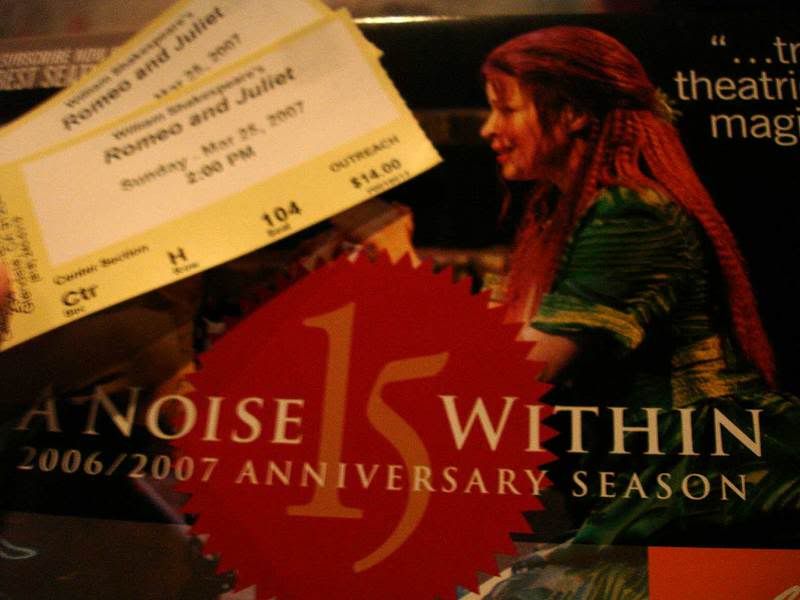 The Children of an Idle Brain
A Review of Romeo and Juliet at A Noise Within
234 S. Brand Blvd., Glendale, CA. 91204
Date: 25 March 2007
The theatre A Noise Within may not seem like a grand structure among the neighboring shopping malls, office buildings, and restaurants. However, this old Masonic temple holds more grandeur within its near century old walls than does its contemporary neighbors. It is in this aging temple/teenage theatre that a nearly full house awaits on pins and needles to partake of the story of star-crossed lovers, blood feuds, and death that is Shakespeare’s Romeo and Juliet.
Director Michael Murray does an awe-inspiring job conveying the comedy, romance, and tragedy of this Shakespearean classic, with the help of a cast of very talented actors of course. All of the actors in Murray’s production of Romeo and Juliet do a splendid job with their character/characters, but there are two players that—in this reviewer’s opinion—steal the show.
J. Todd Adams’ portrayal of Romeo’s fearless, garrulous friend Mercutio is one of the outstanding performances that stole the show, and audience attention—despite his minute break of character when a bulb blew in one of the overhead spotlights. For instance, Adams’ energy and conviction when delivering Mercutio’s throaty Queen Mab oration is unabashedly mind blowing—proving that we all suffer from “the children of an idle brain” (1.4.97). Also, when Mercutio is slain by Ken Merckx’s fiery Tybalt; Adams’ raging sincerity—“A plague o’ both your houses” (3.1.90)!—brought forth tears to some of the audience members eyes—including mine own. Not to mention, that after Mercutio’s tragic death Adams sprung into action with a fire extinguisher when a couch fire broke out in the alley behind the theatre. A fact none of the audience was privy to until after the show was over.
The other scene thief in Murray’s production is the bawdy Nurse, played brilliantly by accomplished actress Deborah Strang. Strang’s portrayal of Juliet’s robust and bawdy nurse commanded the audience’s attention and at times laughter in every scene that dared to contain her—which is quite often. For instance, the point in act two scene four when Adams’ Mercutio playfully accosts Strang’s Nurse left the whole audience in stitches. Most notably when the Nurse beats Michael Thompson’s Peter with her handbag for letting Mercutio use the Nurse “at his pleasure” (2.4.153)—hilarious!
Murray’s production of Romeo and Juliet—Murray has set scene in 1930’s Italy with Tybalt as a Nazi SS officer—is a robust display of gut wrenching comedy and melancholy tragedy. The fight scenes—choreographed by Ken Merckx—are breathtakingly daring. Most notably the initial fray that begins the play, which finds the small stage filled to the brim with action. The first half is exciting, energetic, and comical; while the tragic second half is rightly slower than the hilarious first half of the play. The continued great performance of Mark Bramhall as Friar Laurence is a definite high point of the play’s second half. Although I wasn’t overly impressed with Steve Coombs’ Romeo—Coombs flubbed a couple lines—or Joy Osmanski’s Juliet, the five hour round trip and fourteen dollar admission fee are well worth the experience of seeing a live production of a Shakespeare classic.
Overall, Murray’s production of Romeo and Juliet is a joy to behold, with the modest stage used to its fullest potential and 1930’s costumes—courtesy of Denitsa Bliznakova—are lavish, especially those worn during the masque. A Noise Within will be featuring Murray’s production of Shakespeare’s Romeo and Juliet from March 24 thru May 25. So, grab a friend, loved one, classmate, stranger, or just lone wolf it and go have an awesome theatre experience at A Noise Within, you will not be disappointed.
Work Cited
Shakespeare, William. Romeo and Juliet. The Complete Works of Shakespeare: Shakespeare’s Tragedies, 5th Edition. Ed. David Bevington. New York, NY: Pearson/Longman, 2007. 1009-1050.
Date: 25 March 2007
The theatre A Noise Within may not seem like a grand structure among the neighboring shopping malls, office buildings, and restaurants. However, this old Masonic temple holds more grandeur within its near century old walls than does its contemporary neighbors. It is in this aging temple/teenage theatre that a nearly full house awaits on pins and needles to partake of the story of star-crossed lovers, blood feuds, and death that is Shakespeare’s Romeo and Juliet.
Director Michael Murray does an awe-inspiring job conveying the comedy, romance, and tragedy of this Shakespearean classic, with the help of a cast of very talented actors of course. All of the actors in Murray’s production of Romeo and Juliet do a splendid job with their character/characters, but there are two players that—in this reviewer’s opinion—steal the show.
J. Todd Adams’ portrayal of Romeo’s fearless, garrulous friend Mercutio is one of the outstanding performances that stole the show, and audience attention—despite his minute break of character when a bulb blew in one of the overhead spotlights. For instance, Adams’ energy and conviction when delivering Mercutio’s throaty Queen Mab oration is unabashedly mind blowing—proving that we all suffer from “the children of an idle brain” (1.4.97). Also, when Mercutio is slain by Ken Merckx’s fiery Tybalt; Adams’ raging sincerity—“A plague o’ both your houses” (3.1.90)!—brought forth tears to some of the audience members eyes—including mine own. Not to mention, that after Mercutio’s tragic death Adams sprung into action with a fire extinguisher when a couch fire broke out in the alley behind the theatre. A fact none of the audience was privy to until after the show was over.
The other scene thief in Murray’s production is the bawdy Nurse, played brilliantly by accomplished actress Deborah Strang. Strang’s portrayal of Juliet’s robust and bawdy nurse commanded the audience’s attention and at times laughter in every scene that dared to contain her—which is quite often. For instance, the point in act two scene four when Adams’ Mercutio playfully accosts Strang’s Nurse left the whole audience in stitches. Most notably when the Nurse beats Michael Thompson’s Peter with her handbag for letting Mercutio use the Nurse “at his pleasure” (2.4.153)—hilarious!
Murray’s production of Romeo and Juliet—Murray has set scene in 1930’s Italy with Tybalt as a Nazi SS officer—is a robust display of gut wrenching comedy and melancholy tragedy. The fight scenes—choreographed by Ken Merckx—are breathtakingly daring. Most notably the initial fray that begins the play, which finds the small stage filled to the brim with action. The first half is exciting, energetic, and comical; while the tragic second half is rightly slower than the hilarious first half of the play. The continued great performance of Mark Bramhall as Friar Laurence is a definite high point of the play’s second half. Although I wasn’t overly impressed with Steve Coombs’ Romeo—Coombs flubbed a couple lines—or Joy Osmanski’s Juliet, the five hour round trip and fourteen dollar admission fee are well worth the experience of seeing a live production of a Shakespeare classic.
Overall, Murray’s production of Romeo and Juliet is a joy to behold, with the modest stage used to its fullest potential and 1930’s costumes—courtesy of Denitsa Bliznakova—are lavish, especially those worn during the masque. A Noise Within will be featuring Murray’s production of Shakespeare’s Romeo and Juliet from March 24 thru May 25. So, grab a friend, loved one, classmate, stranger, or just lone wolf it and go have an awesome theatre experience at A Noise Within, you will not be disappointed.
Work Cited
Shakespeare, William. Romeo and Juliet. The Complete Works of Shakespeare: Shakespeare’s Tragedies, 5th Edition. Ed. David Bevington. New York, NY: Pearson/Longman, 2007. 1009-1050.
Sunday, April 15, 2007
Romeo and Juliet at A Noise Within
Sunday, March 25, my English 235 Shakespeare class and I took a big white van down south to Glendale to see Romeo and Juliet at A Noise Within. For many of my students, this was a first time experience with live Shakespeare (for some, live drama altogether), and so this was a particularly special event.


A Noise Within is located in an old converted Masonic Temple Building in downtown Glendale and is the only theater company in Southern California working in the repertory tradition. The company produces six plays annually and has won numerous awards including twenty-five (yes, twenty-five!) Los Angeles Drama Critics’ Circle awards. Not surprisingly, their production of Romeo and Juliet, lived up to their pedigree.
Please check back here in the near future for student reviews of the performance.
A Noise Within is located in an old converted Masonic Temple Building in downtown Glendale and is the only theater company in Southern California working in the repertory tradition. The company produces six plays annually and has won numerous awards including twenty-five (yes, twenty-five!) Los Angeles Drama Critics’ Circle awards. Not surprisingly, their production of Romeo and Juliet, lived up to their pedigree.
Please check back here in the near future for student reviews of the performance.
Friday, February 23, 2007
More Whiskey Flat Days Fun
 Yes, Whiskey Flat Days is a fun-filled weekend. However, there is tons of history behind this annual event. Kernville, California was first established during the Gold Rush days, but was known as the town of Whiskey Flat. Many miners were travelling through this region and a man by the name of Adam Hamilton saw this as a great business prospect. Hamilton set up a tent next to the Kern River and began selling whiskey to the prospecters that came through the valley. Next thing you know, Whiskey Flat was a town.
Some years later, a dam was built on the Kern River that created our own Lake Isabella. When this happened, the town of Whiskey Flat had to be relocated to a higher spot on the mountain. This is when the town became Kernville, as we know it today. As the Gold Rush dwindled down, people began to really settle into the town of Kernville. However, they were faced with a challenge: not many people wanted to travel all the way up here in the mountains. So, they decided to devise a plan that would bring tourists, and therefore more money into the town. Without tourism, the people knew that Kernville would not last.
The people agreed to have some kind of a celebration to attract people. According to The Kern Valley Sun, "Lloree Knowles, a local real estate broker, was the first to recommend that the community use a frontier-type celebration to try to bring more people into the Valley during the slack winter period." Then, Ardis Walker, a local historian and author, suggested the name  "Whiskey Flat Days" because he thought that it would be a great way to showcase the town's historic past. The first Whiskey Flat Days kicked off in 1958 and has been growing ever since.
There you have it! The history of Whiskey Flat Days in Kernville, California.
As Candace said, there is so much to see here...and some GREAT artwork too.
But for me, the best part is that it offers fun for the whole family.
Tuesday, November 21, 2006
Men of Worth
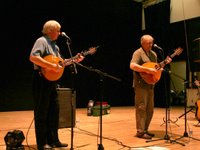
This past Friday I had the pleasure of attending a concert featuring the Celtic duo Men of Worth. I’ve seen this duo many times over the past 9 years that they have been coming to Cerro Coso College. Each Fall Men of Worth has entertained concert goers with their humor, casual and friendly attitude, and of course their wonderful folk music.
This concert is a treasure to all who attend. The back and forth friendly banter always draws a laugh, and James and Donnie know how to draw the audience in. Their ability to adapt on the fly, to bring attention in a light-hearted way to someone coming in late or clapping off beat, always amuses the audience. The concert is very informal and the audience is often regaled with stories of their travels to the location, or rather mishaps along the way. The musicians also share stories about the music, helping the audience to understand the meaning behind the words or the relevant history to help enlighten the listener to the significance of the songs. Songs are performed in both English and Gaelic and include exciting tunes and heartfelt ballads.
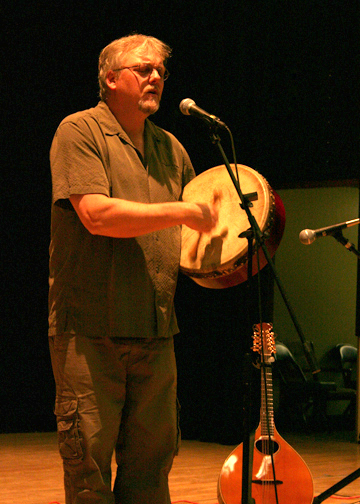
Something that really sets these musicians apart is that they welcome the audience to come down during the mid-concert break and talk with them and look at their instruments, which include a mandolin, accordion, bodhrans, guitar, concertina, banjo and mandola. Because of the intimate atmosphere at their concert you really feel like you’re enjoying an evening with a couple of old friends. James and Donnie have often said that their visit to Cerro Coso is one of their favorite stops on their fall concert tour, and for this concert goer, it is one of my favorite Fall events to attend.
Men of Worth was formed in 1986 by James Keigher from Ireland and Donnie Macdonald from Scotland. They currently reside in Southern Oregon and Northern California, the duo travel frequently, bringing the Gaelic culture to audiences throughout the western states. Learn more about Men of Worth by visiting their website, and look forward to their 2007 concert to be held next November.

This concert is a treasure to all who attend. The back and forth friendly banter always draws a laugh, and James and Donnie know how to draw the audience in. Their ability to adapt on the fly, to bring attention in a light-hearted way to someone coming in late or clapping off beat, always amuses the audience. The concert is very informal and the audience is often regaled with stories of their travels to the location, or rather mishaps along the way. The musicians also share stories about the music, helping the audience to understand the meaning behind the words or the relevant history to help enlighten the listener to the significance of the songs. Songs are performed in both English and Gaelic and include exciting tunes and heartfelt ballads.
Something that really sets these musicians apart is that they welcome the audience to come down during the mid-concert break and talk with them and look at their instruments, which include a mandolin, accordion, bodhrans, guitar, concertina, banjo and mandola. Because of the intimate atmosphere at their concert you really feel like you’re enjoying an evening with a couple of old friends. James and Donnie have often said that their visit to Cerro Coso is one of their favorite stops on their fall concert tour, and for this concert goer, it is one of my favorite Fall events to attend.
Men of Worth was formed in 1986 by James Keigher from Ireland and Donnie Macdonald from Scotland. They currently reside in Southern Oregon and Northern California, the duo travel frequently, bringing the Gaelic culture to audiences throughout the western states. Learn more about Men of Worth by visiting their website, and look forward to their 2007 concert to be held next November.


Tuesday, November 07, 2006
Creative Expressions Art Show Review
This past weekend I attended the Creative Expressions Art Show. What a plethora of talent! There was a variety of paintings, some graphite and colored pencil work, ceramics, gourd art, rock art, candles, decorated artificial trees, pottery, and cut paper Chinese pictures. The Chinese cut paper work was amazing, the delicacy of the paper, and the intricacy of the designs just blew me away; I even had to ask if they were all done by hand. Nna Chapman, the artist, showed me that all of work was done with just an ordinary cutting razor, just like the kind you’d find in any craft section, the ones with breakaway blades. That blew me away even more, I was sure that she must use some special tool to create her art.
I spoke with one of the jewelry artists whose abalone necklaces caught my eye (and whose fake ice crystal decorations enthralled my 3-year old). I asked where she got her materials and she said that she frequents bead stores while on travel and collects a multitude of beads and materials and then later designs the jewelry. She said that sometimes she’ll have a single art bead for years before she finds the coordinating beads that will complete the design. I was very impressed with her work, and especially the variety of her designs. I’ll definitely be back at her table again at Santa’s Art Shop, the next major local arts and crafts festival.
I was also able to meet Lois Hinman, a fabulous local artist whose ceramics work and paintings are very high quality, and Kathi Moe, who both organized the art show. Hinman has been involved with pottery for 30 years, and painting for the past 12. Moe has is a long-time Creative Expressions member, whose tole painting and wearable art has been seen, collected, and worn in Ridgecrest for many years.
The artist I was most interested to check out was Paula Caudill (Dragonfly Pottery), a friend and colleague, whose work I’ve admired for some time. Paula is a painter and ceramic artist who got her start in ceramics at Cerro Coso College where she first took ceramic classes, and received her A.A. in Art. Paula has been a resident of Ridgecrest for many years, leaving for a brief time to pursue her Bachelor’s degree in Art at Humboldt State University. Paula’s sculpture and paintings are very expressive and her pottery demonstrates a solid skill in both form and function. Paula is ever one to explore new things, and I was intrigued by her creations using polymer clay over glass – kaleidoscope of color with flowing patterns that look like an explosion of color. Her polymer work included plates, bowls, cups, flower vases, and candle vases, which when illuminated had the most wonderful translucent stone appearance.
We also talked about a new glaze she was using that had a deep teal color that was very appealing. I inquired about some of the different glazes as some appeared to be over porcelain and were very smooth, while others were darker and rough. I was surprised to learn that there were several pieces that used the same glaze, but were used over different clay bodies, one being white stoneware clay, the other being rich dark ‘electric brown’ clay. It was amazing the difference that the clay itself made to the results of the glaze. Having worked with only a few glazes and single type of clay in my own experience, it was a pleasure to learn more about how the clay body affects the glazing process.
Paula invited me, and any other interested persons, to come to an upcoming show the “Potted Barn” on December 9th from 9 to 4 at one of the participating artists studios located at 2168 S. Gateway, Ridgecrest, where more of her work will be displayed and sold. The Potted Barn started as a group of potters but it has expanded to include jewelry, metal work, and a variety of artistic creations. Hopefully I’ll have a chance to check out the Potted Barn and will share my discoveries after the visit. Check back for more information about upcoming art shows and artists in the Indian Wells and Kern River Valley area.


Paula Caudill, Dragonfly Pottery

Wednesday, November 01, 2006
Creative Expressions Art Show
This weekend the Creative Expressions art show comes to Ridgecrest. Creative Expressions is a community of local artists that was formed nearly twenty years ago by artists Kathi Moe, Lois Hinman, Donnie Woods, and other locals. The Creative Expressions show, offered twice a year, features the work of member and guest artists from the local community. Participating artists have an opportunity not only to share, but also to sell their work. The range of art is wide, from pottery to paintings to jewelry, crafts, rock art, and more. For anyone interested in art and the crafts of local artisans, this is a wonderful opportunity to partake of the talent in the Indian Wells Valley.
The Creative Expressions is showing from 9am to 5pm Friday and Saturday, November 3rd and 4th at the Kerr McGee Center in Ridgecrest, California. Admission is free.
Look for a follow-up article featuring my visit to the Creative Expressions art show, and my review of the work of local artist Paula Caudill.
The Creative Expressions is showing from 9am to 5pm Friday and Saturday, November 3rd and 4th at the Kerr McGee Center in Ridgecrest, California. Admission is free.
Look for a follow-up article featuring my visit to the Creative Expressions art show, and my review of the work of local artist Paula Caudill.
Subscribe to:
Posts (Atom)